酉鸡
A call to dawn. A promise of good fortune.
Discover the bird of five virtues, the art of auspicious wordplay and the faithful voice that welcomes a new day.
Explore the story ↗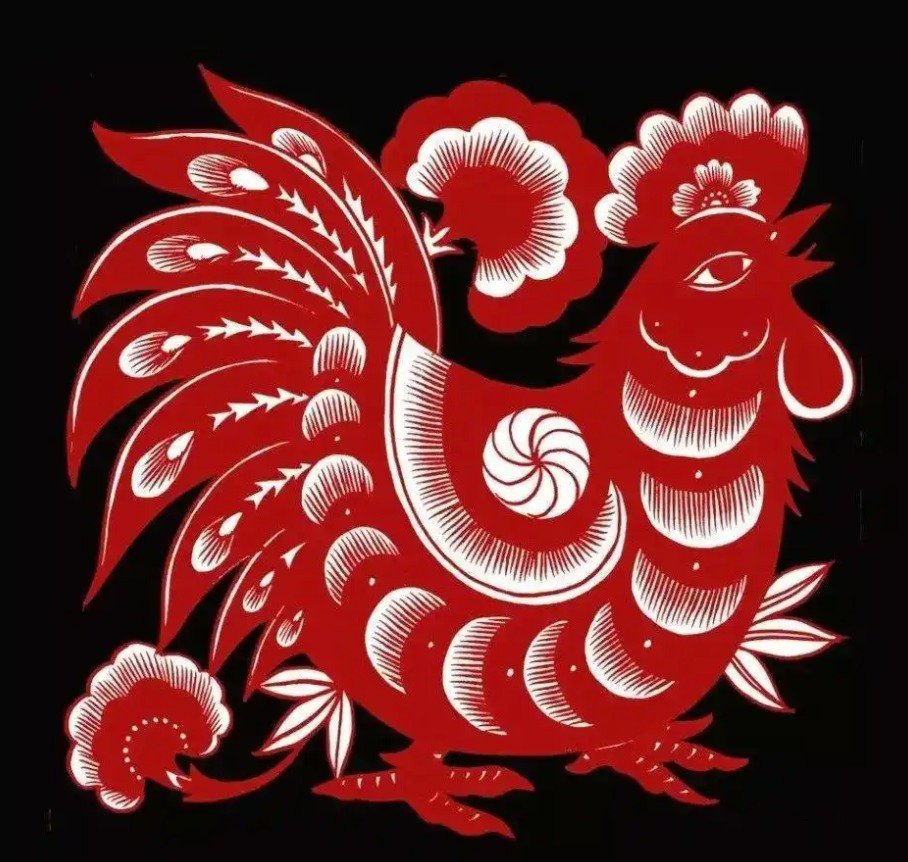
How the Rooster joined the zodiac
1. Honesty and gratitude
One legend tells of the Jade Emperor choosing the twelve zodiac animals. The Rooster earned a chance to compete through its splendid feathers and ringing voice, but a wide river blocked its journey to heaven. Unable to swim across in the story, it accepted the Dog’s help and rode on its back. The crossing soaked the Rooster’s feathers and dulled their beauty. When the emperor asked what had happened, the Rooster told the truth and gratefully acknowledged the Dog’s kindness. Admiring its honesty and gratitude, the emperor gave it a place in the zodiac.
2. The faithful herald of dawn
The Rooster’s dawn crowing gave it a sacred quality in traditional imagination. Another legend says that 黄帝 (Huáng Dì), the Yellow Emperor, wished to revise the calendar and choose twelve animals to represent the twelve months. The Rooster’s ability to announce daybreak won it a place, making it an emblem of wisdom and diligence.
A related folk story returns to the Jade Emperor: the Rooster secured its place with a ‘golden voice.’ At the first light of every morning, its powerful call awakened the sleeping world. Grateful for this tireless, dependable service, people asked the emperor to honor it with a zodiac title.
Why is the Rooster paired with Yǒu?
1. Evening and the autumn harvest
酉时 (yǒu shí) is the traditional two-hour period from 5 p.m. to 7 p.m., associated with sunset and dusk. The source links this period with chickens returning to their roosts. Their evening rhythm provides a traditional explanation for the pairing, although actual roosting times depend on daylight and conditions.
Yǒu is classified as yin and corresponds to the eighth lunar month, a time of autumn harvest. Its symbolism emphasizes maturity, gathering and withdrawal. Chickens settling into their roosts at dusk echo this image of life turning inward.
2. The character and its meanings
The source describes the oracle-bone form of 酉 (yǒu) as a round-bellied wine jar, with a lid above, a vessel body below and markings in the middle.
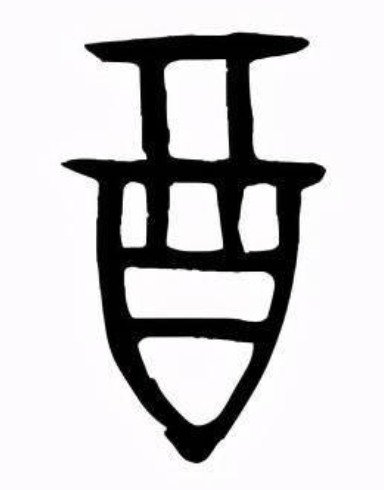
Shuowen Jiezi associates yǒu with completion: millet ripens in the eighth month and can be brewed into strong grain wine. Because the vessel and its contents connect with harvested grain, the source reads the character as a symbol of ripeness and completed growth.
The dictionary also discusses 丣, an old form of 酉, through the image of seasonal gates. 卯 (mǎo) is the spring gate, through which living things emerge; yǒu is the autumn gate, through which they return inward. A horizontal stroke is interpreted as a closed door.
The Rooster’s morning call evokes mǎo and the outward energy of dawn; its evening roosting evokes yǒu and inward rest. In traditional branch relationships, mǎo and yǒu stand opposite one another: mǎo is paired with the Rabbit, yǒu with the Rooster. The source uses this contrast to describe the bird as expressing both the yang of morning and the yin of evening.
3. Metal, autumn and the west
In 五行 (wǔ xíng), the Five Phases of traditional cosmology, yǒu belongs to yin metal. The source also assigns the Rooster to metal within traditional divinatory thought, using the term 巽金 (xùn jīn). It links the bird’s golden-red plumage and its call dispelling the night with metal’s qualities of clarity, restraint and autumnal gathering. These are symbolic correspondences within the article’s traditional interpretation.
Yǒu is associated with the west and autumn. In this framework, metal represents both seasonal severity and firmness. Claws likened to iron hooks and a beak compared with a chisel give the Rooster an image of strength and sharpness that complements these qualities.
4. Yin, yang and the counting of toes
The source describes a traditional matching scheme based on feet, numbers and perceived character. Yǒu is tenth in the branch sequence, an even-numbered position associated with yin. Chickens typically have four toes, while roosters also develop a spur behind the leg. The article invokes these features in its symbolic explanation of the pairing with yin metal.
Another traditional account calls the Rooster a bird of fire: its crowing accompanies sunrise, while its evening rest brings it into yin and the metal of yǒu. The two images—daytime activity and gathering inward at dusk—offer a further cultural explanation for its branch association.
What the Rooster symbolizes
1. The bird of five virtues
The ancient collection Hanshi Waizhuan interprets the Rooster’s appearance and behavior through five moral qualities. Its crown, spurs, courage, sharing of food and dependable timekeeping become lessons in human conduct.
Refinement · 文 (wén). The red comb and colorful feathers resemble the ceremonial headdress and dignified dress of a cultivated person.
Martial readiness · 武 (wǔ). The spur behind the leg, together with sharp claws and a pointed beak, suggests a creature equipped to defend itself.
Courage · 勇 (yǒng). The bird faces an opponent and stands its ground. Historical cockfighting supplied imagery of martial spirit. The expression 呆若木鸡 (dāi ruò mù jī), ‘still as a wooden rooster,’ originally praised the profound composure of a trained fighting bird; its familiar later meaning is to look stunned or vacant.
Benevolence · 仁 (rén). A chicken that finds food and calls others to it becomes an image of sharing instead of keeping everything for itself.
Trustworthiness · 信 (xìn). The regular announcement of dawn makes the Rooster a ‘time-knowing animal,’ a symbol of keeping promises and practicing self-discipline.
2. Good fortune in pictures and wordplay
鸡 (jī), ‘chicken,’ sounds similar to 吉 (jí), ‘auspicious.’ Folk wordplay also hears 酉鸡 (yǒu jī) as 有吉 (yǒu jí), ‘there is good fortune.’ New Year prints and decorative objects pair the bird with wishes such as 大吉大利 (dà jí dà lì), great good fortune and prosperity, and 吉祥如意 (jí xiáng rú yì), auspicious blessings and fulfilled wishes.
Artists combine the Rooster with other objects to turn spoken blessings into pictures. The source gives four familiar examples:
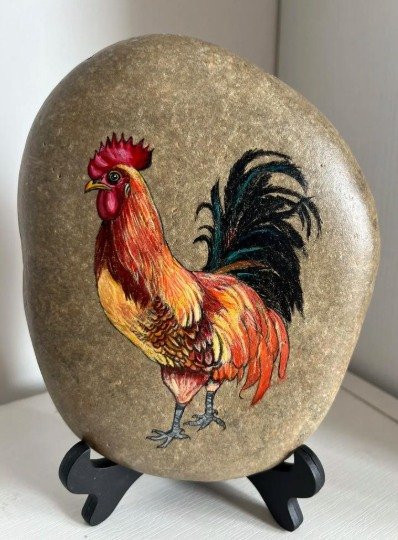
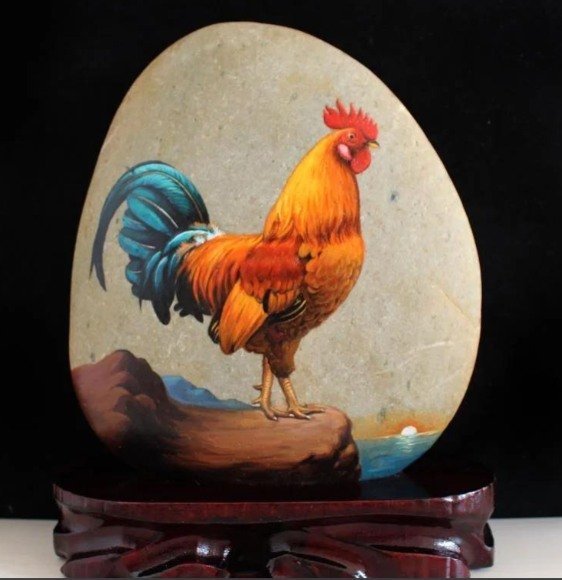
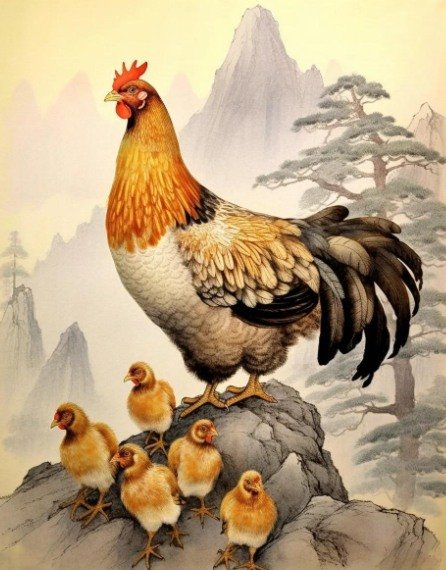
A rooster on a rock evokes 室上大吉 (shì shàng dà jí), a wish for good fortune in the home, through wordplay on ‘rock’ and ‘household.’ The accompanying illustrations show roosters painted on stone.
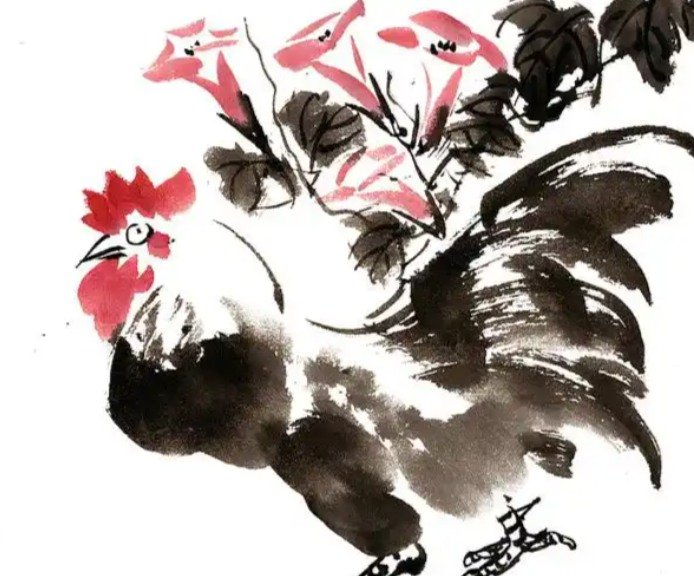
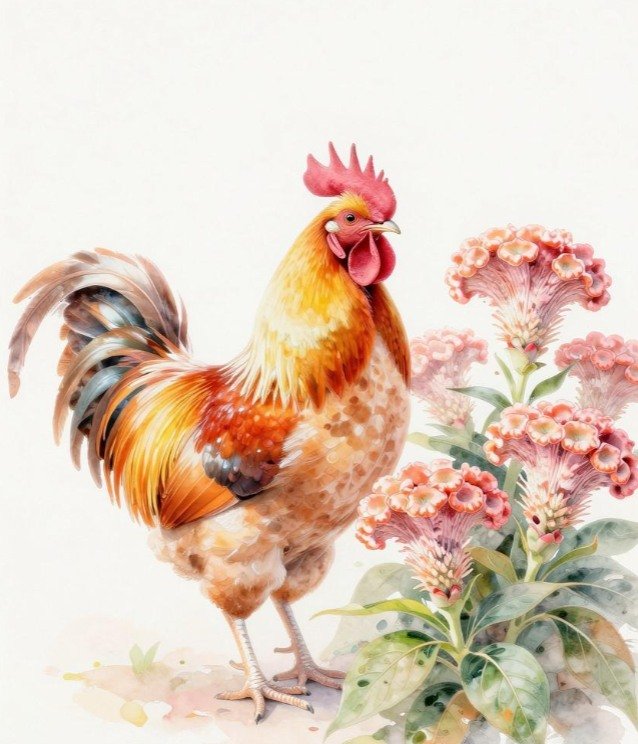
A rooster beside cockscomb flowers expresses 官上加官 (guān shàng jiā guān), promotion upon promotion. 冠 (guān), the comb or crown, sounds like 官 (guān), an official position.
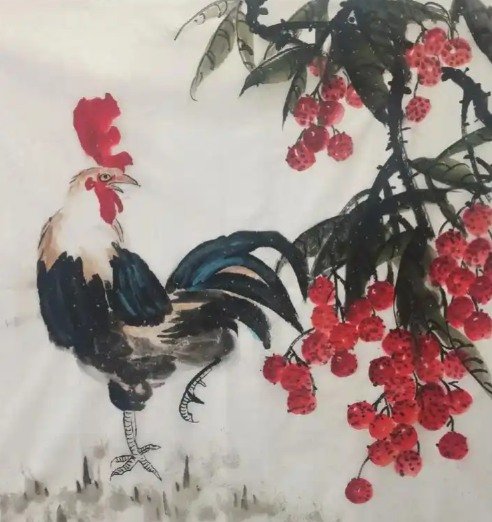
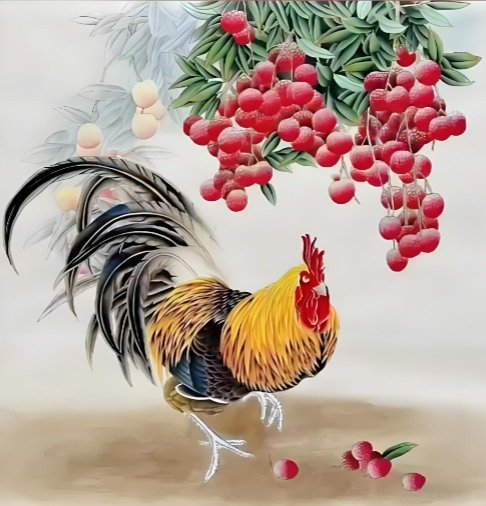
A rooster with lychees suggests 吉利万千 (jí lì wàn qiān), countless auspicious blessings, through the sounds of the words for chicken and lychee.
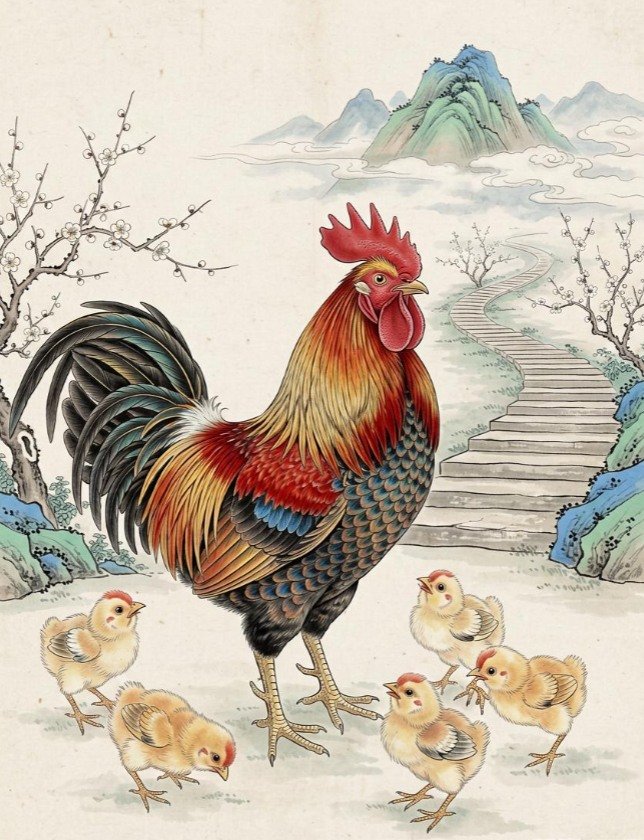
A rooster with five chicks forms 五子登科 (wǔ zǐ dēng kē), ‘five sons succeed in the examinations.’ The image celebrates scholarly achievement and success in the imperial examination tradition.
3. Protection against harmful spirits
In folk belief, the Rooster’s dawn call disperses darkness, and its strong yang presence can repel harmful spirits. The source describes chickens in funerary, sacrificial, protective and oath-taking rituals. Accounts of blood oaths associate chicken blood with pledged loyalty witnessed by heaven and earth; ancestral offerings and protective rites likewise use it symbolically. These descriptions concern traditional ritual beliefs, not proven supernatural effects or instructions for practice.
4. Punctuality and keeping faith
Before clocks were widely available, people used the crowing of roosters as a familiar cue for morning activity. The Book of Songs depicts the cock already crowing and the court already filling with people. Announcing daybreak and calling households to work, the Rooster became a vivid emblem of reliability, punctuality and faithful service.
5. Courage in the face of a challenge
Roosters may fight intensely in defense or competition. Their willingness to confront an opponent has therefore also made them a cultural image of courage and determination.
Folk customs and beliefs
1. New Year pictures and the first day
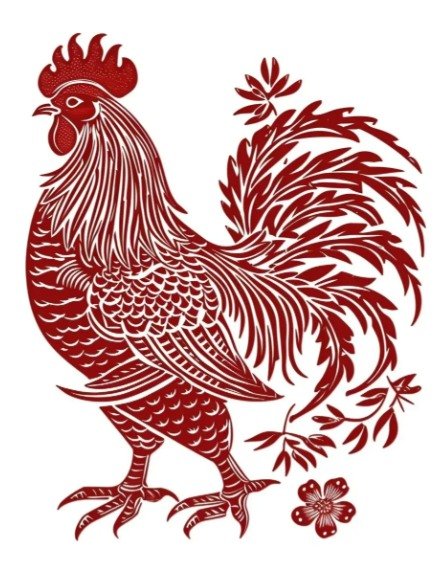
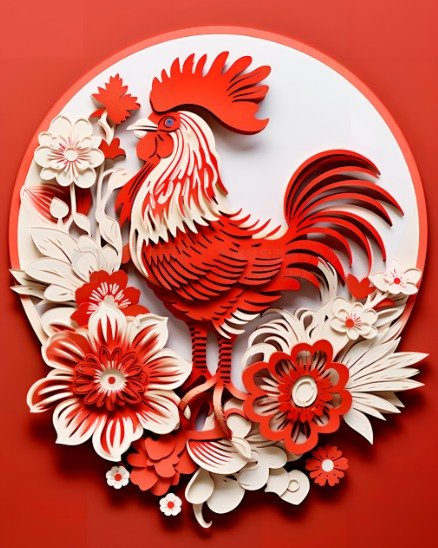
In a folk creation story, 女娲 (Nǚ Wā) makes chickens on the first day of the first lunar month, followed by dogs, pigs, sheep or goats, cattle and horses on the next five days; humans come on the seventh. This makes New Year’s Day ‘Chicken Day.’ People placed painted, carved or paper-cut chickens on doors and windows as protective household images.
Jingchu Suishiji, a record of seasonal customs, describes pictures of chickens on doors together with hanging reed ropes and peachwood charms. The arrangement was believed to frighten away spirits and protect the home.
2. Food and wishes at the family table
A whole chicken at a New Year’s Eve dinner or festive banquet conveys wishes for good fortune. In customs described by the source, the head is offered to an elder or honored guest as a symbol of leadership; wings go to young people and students with wishes that they will soar; legs go to younger family members with hopes that they will remain grounded and take responsibility for the household.
The article also records old taboos against children eating chicken feet or brains: the former were said to cause untidy handwriting, the latter poor memory. The source explicitly identifies these as unfounded folk beliefs.
3. Weddings, funerals and regional differences
Traditional ceremonies may choose birds by plumage color. The source describes white chickens as commonly associated with funerals and sacrifices, while red-feathered roosters, regarded as rich in yang, appear in weddings and other celebrations. Local traditions differ, including exceptions in marriage rites where a rooster serves as a ceremonial object.
Idioms, proverbs and everyday wisdom
Each entry presents the original Chinese, its pronunciation in pinyin, an English rendering and an explanation of its meaning. These expressions explore diligence, good fortune, human behavior and practical wisdom. The final seven are two-part sayings known as 歇后语 (xiē hòu yǔ).
闻鸡起舞
Rise at the rooster’s call to practice swordsmanship
To pursue one’s ambitions with diligence and determination, beginning work early.
金鸡报晓
The golden rooster announces dawn
A symbol of arriving light, fresh beginnings and renewal.
呆若木鸡
Still as a wooden rooster
In the Zhuangzi story, a trained fighting rooster is so composed that nothing disturbs it. The later everyday meaning is to stand stunned, blank-faced or motionless.
鹤立鸡群
A crane stands among chickens
To stand out from the crowd through exceptional ability, bearing or appearance.
鸡犬不宁
Even chickens and dogs cannot find peace
A disturbance is so severe that an entire household or community is unsettled.
鸡犬升天
Even the chickens and dogs ascend to heaven
When one person gains power or success, relatives and associates benefit too. It echoes the saying that when someone attains the Dao, even their animals rise to heaven.
鸡犬相闻
Roosters and dogs can be heard from one village to another
An image of nearby rural settlements and peaceful country life, familiar from The Peach Blossom Spring.
杀鸡儆猴
Kill a chicken to warn the monkeys
To punish one person as a warning to others. Also written 杀鸡吓猴 (shā jī xià hóu).
杀鸡取卵
Kill the chicken to get its eggs
To sacrifice lasting benefit for a small, immediate gain.
偷鸡摸狗
Steal chickens and sneak off with dogs
To engage in petty theft or other dishonest, furtive behavior; it can also refer disapprovingly to illicit sexual affairs.
鸡飞蛋打
The chicken flies away and the eggs are broken
To lose on both fronts and end up with nothing.
鸡飞狗跳
Chickens fly and dogs leap
A scene of noisy confusion and commotion.
鸡毛蒜皮
Chicken feathers and garlic skins
Trivial matters too small to deserve serious concern.
宁为鸡口,勿为牛后
Better the mouth of a chicken than the rear of an ox
Better to have independence in a small setting than remain subordinate in a larger one.
嫁鸡随鸡,嫁狗随狗
Marry a chicken, follow the chicken; marry a dog, follow the dog
An old marriage saying that expected a wife to follow her husband’s circumstances and fate. It records a historical social expectation, rather than advice for relationships today.
手无缚鸡之力
Without the strength to tie up a chicken
To be physically weak or have very little strength.
黄鼠狼给鸡拜年 —— 没安好心
A weasel pays the chicken a New Year visit — with no good intentions
A show of friendliness conceals a harmful motive.
杀鸡用牛刀 —— 小题大做
Use an ox-cleaving knife to kill a chicken — make too much of a small matter
To use excessive force or effort for a minor task.
鸡窝里飞出金凤凰 —— 异想天开
A golden phoenix flies out of a chicken coop — a fanciful idea
The supplied article uses this two-part saying for an extravagant or far-fetched expectation.
斗败的公鸡 —— 垂头丧气
A defeated rooster — head hanging in dejection
To look discouraged and dispirited after a setback.
公鸡下蛋 —— 没指望
A rooster laying an egg — no hope of it
An outcome that cannot reasonably be expected.
小鸡吃米 —— 一点一点来
A chick eating rice — a little at a time
Make progress gradually, one small step after another.
偷鸡不成 —— 蚀把米
Fail to steal the chicken — and lose a handful of rice
An attempt at improper gain backfires, leaving the schemer worse off.