A year, finely observed.
Follow the sun through a calendar of rain, ripening grain, dew and snow. Twenty-four moments connect the sky above with everyday life below.
Begin exploring ↗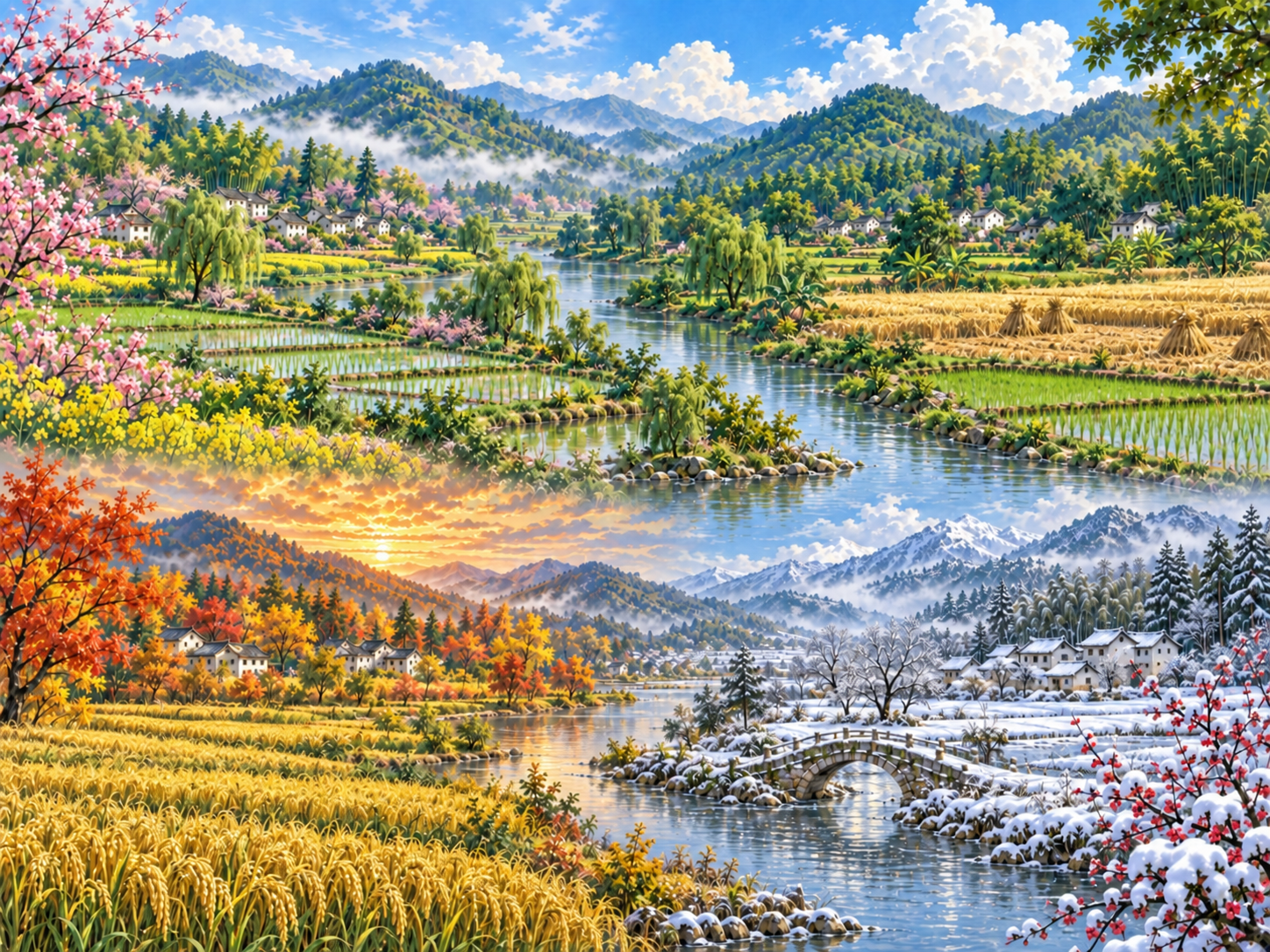
A calendar written in sunlight
The twenty-four solar terms are a Chinese knowledge system shaped by observation of the Sun’s annual motion. They connect the naming of time with farming, seasonal change and community customs. UNESCO inscribed the tradition on its Representative List of the Intangible Cultural Heritage of Humanity in 2016.
The system has roots in the Yellow River region. The supplied article traces its development from the pre-Qin period to its establishment in the Han era, as a seasonal guide alongside the traditional calendar. It praises its importance with the expression “China’s fifth great invention,” a celebratory description rather than an official scientific ranking.
The modern terms mark the Sun’s apparent ecliptic longitude at 15° intervals. The spring equinox is 0°; Summer Solstice is 90°, Autumn Equinox 180°, and Winter Solstice 270°. This is not a division into equal numbers of days. The traditional named sequence starts with Beginning of Spring and ends with Major Cold.
There are about two terms per Gregorian month. Alternating entries are called 节 (jié), sectional terms, and 中气 (zhōng qì), principal terms; together they form the seasonal framework. Their dates stay fairly close from year to year, but the exact moment depends on the year and time zone.
Twenty-four ways to notice a year
立春
Beginning of SpringWarming begins; buds stir and farmers prepare the fields.
雨水
Rain WaterMore rain, thawing ice and the gradual return of warmth.
惊蛰
Awakening of InsectsSpring thunder and stirring creatures signal a busy growing season.
春分
Spring EquinoxDay and night are approximately balanced; spring cultivation gathers pace.
清明
Pure BrightnessClear spring scenery, growing crops, outings and remembrance of ancestors.
谷雨
Grain RainLate-spring rain nourishes grain and other growing crops.
立夏
Beginning of SummerThe traditional summer season opens with vigorous growth.
小满
Grain BudsGrain begins to fill but is not yet ripe; rainfall can become abundant.
芒种
Grain in EarHarvesting awned grain and sowing crops make this a busy farming period.
夏至
Summer SolsticeThe Northern Hemisphere reaches its longest day; summer heat continues to build.
Read the illustrated story ↗
小暑
Minor HeatHeat and humidity intensify as the hottest part of summer approaches.
大暑
Major HeatTraditionally associated with the height of summer heat and humidity.
立秋
Beginning of AutumnAutumn begins in the traditional calendar, though summer heat may linger.
处暑
End of HeatThe name marks heat withdrawing and cooler mornings and evenings.
白露
White DewCooler nights leave dew, while differences between day and night grow.
秋分
Autumn EquinoxDay and night are approximately balanced again; harvest season advances.
寒露
Cold DewDew feels colder and late-autumn harvesting continues.
霜降
Frost’s DescentThe traditional image is arriving frost and fading vegetation.
立冬
Beginning of WinterThe traditional winter season opens: gathering inward, storing and resting.
小雪
Minor SnowThe name evokes the arrival of lighter snowfall in colder regions.
大雪
Major SnowDeepening cold and heavier snow are the traditional seasonal images.
冬至
Winter SolsticeThe Northern Hemisphere’s shortest day; daylight subsequently begins to increase.
小寒
Minor ColdA stage of deep winter cold, sometimes colder locally than Major Cold.
大寒
Major ColdThe final term evokes severe cold before the cycle returns to spring.
Beginnings, solstices and equinoxes
四立 · Sì lì — Four beginnings
立 (lì) means beginning. Beginning of Spring, Summer, Autumn and Winter traditionally open the four seasons, near February 4, May 5, August 7 and November 7. These calendar markers need not coincide with local weather changing on that day.
二至 · Èr zhì — Two solstices
至 (zhì) evokes an extreme or turning point. Near the June solstice the Sun is overhead at the Tropic of Cancer, about 23.4° north; near the December solstice it is overhead at the Tropic of Capricorn, about 23.4° south. The longest and shortest Northern Hemisphere days are light extremes, not necessarily temperature extremes.
二分 · Èr fēn — Two equinoxes
At the equinoxes the Sun crosses the celestial equator. Day and night are approximately equal, rather than precisely twelve hours everywhere. These occur around March 20 and September 22–23.
Four kinds of seasonal names
The source groups eight terms by seasonal turning points; five by heat or cold (Minor Heat, Major Heat, End of Heat, Minor Cold, Major Cold); seven by rain, dew, frost or snow; and four by living things or farming (Awakening of Insects, Pure Brightness, Grain Buds and Grain in Ear). Dew and frost are grouped as moisture-related imagery, rather than all being rainfall.
A calendar remembered in rhyme
A farming year in twelve couplets
打春阳气转,雨水沿河边。
Spring begins and yang turns; Rain Water brings moisture along the river.
惊蛰乌鸦叫,春分地皮干。
Crows call at Awakening of Insects; the ground surface dries at the Spring Equinox.
清明忙种麦,谷雨种大田。
Pure Brightness brings wheat sowing; Grain Rain brings planting across the fields.
立夏鹅毛住,小满雀来全。
At Beginning of Summer the goose-feather snow ceases; by Grain Buds the birds have gathered.
芒种开了铲,夏至不纳棉。
Grain in Ear begins the hoeing; Summer Solstice puts quilted cotton sewing aside.
小暑不算热,大暑三伏天。
Minor Heat is not the hottest; Major Heat brings the sweltering dog days.
立秋忙打靛,处暑动刀镰。
Beginning of Autumn brings indigo work; End of Heat sets the sickles moving.
白露忙割地,秋分把地翻。
White Dew brings harvesting; the Autumn Equinox brings turning the soil.
寒露不算冷,霜降变了天。
Cold Dew is not yet bitter cold; Frost’s Descent changes the weather.
立冬交十月,小雪地封严。
Beginning of Winter meets the tenth lunar month; Minor Snow seals the ground.
大雪河叉上,冬至不行船。
Major Snow closes the river channels; at Winter Solstice boats no longer sail.
小寒再大寒,转眼又一年。
Minor Cold, then Major Cold; in a moment another year has passed.
More voices from the fields
春分一到昼夜平,耕田保墒要先行。
At the Spring Equinox day and night balance; prioritize tillage that conserves soil moisture.
惊蛰种麦堆满仓,清明种麦一把糠。
Wheat sown at Awakening of Insects fills the storehouse; wheat sown at Pure Brightness leaves only chaff. A local warning about planting too late.
谷雨前后,种瓜点豆。
Around Grain Rain, plant melons and sow beans.
白露早,寒露迟,秋分种麦正当时。
White Dew is early, Cold Dew late; the Autumn Equinox is just right for sowing wheat.
一场春雨一场暖,一场秋雨一场寒。
Each spring rain brings warmth; each autumn rain brings cold.
芒种芒种,连收带种。
Grain in Ear: harvesting and sowing together.
处暑雨,粒粒皆是米。
Rain at End of Heat: every drop is grain.
寒露蚕豆霜降卖,种了小麦种大麦。
The supplied wording links Cold Dew broad beans with sales at Frost’s Descent, then wheat and barley sowing. Its regional meaning and wording are uncertain.
冬至晴,新年雨;冬至雨,新年晴。
A clear Winter Solstice foretells a rainy New Year; a rainy solstice, a clear New Year. A folk forecast, not a dependable prediction.
The short mnemonic
春雨惊春清谷天,夏满芒夏暑相连。
Initial words recall the six spring terms, then the six summer terms in sequence.
秋处露秋寒霜降,冬雪雪冬小大寒。
The autumn sequence follows, then winter’s two snows, solstice and two colds.
上半年逢六廿一,下半年逢八廿三。
An approximate memory aid places terms around the 6th and 21st in the first half of the year, the 8th and 23rd in the second.
每月两节日期定,最多相差一二天。
Two terms each month on fairly steady dates, with small shifts. For an exact date, use an astronomical calendar for the year and time zone.
Astronomical reference: Hong Kong Observatory — the 24 solar terms. Heritage record: UNESCO — Twenty-Four Solar Terms. Main text adapted from the supplied Chinese documents. Generated illustrations are interpretive artwork, not historical photographs.