Seven
Stars, meetings and measured intervals. Seven travels between the night sky, festival stories and religious rhythms. Its recurring appearances do not all share one origin.
A crossing stroke
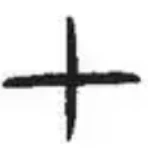
The earliest forms of 七 (qī) look like crossing strokes. One influential explanation connects the graph with cutting and a later borrowing for the numeral. The received dictionary tradition also gives it a cosmological reading. Those are different kinds of explanation.
It is tempting to turn seven into a universal law of change. A more careful approach asks what a particular text, custom or calendrical system is actually counting.
Seven lights above
The 七曜 (qī yào, seven luminaries) are the sun, moon and five planets visible to the unaided eye. The 北斗七星 (běi dǒu qī xīng, seven stars of the Northern Dipper) form another group. These two sevens must not be confused.
The Dipper’s changing position offered a way to relate the night sky to the seasons, when observed at comparable times. Its familiar Chinese star names are Tian Shu, Tian Xuan, Tian Ji, Tian Quan, Yu Heng, Kai Yang and Yao Guang. A seven-day week has a separate history of transmission and cannot simply be derived from these seven stars.
The Changes phrase “return in seven days” has inspired several explanations. It should be read as a debated textual image, not a scientific claim that every living thing or historical event changes on a seven-day schedule.
The seventh day, the seventh night
人日 (rén rì), the seventh day of the first lunar month, became associated with humanity’s birthday. Stories connecting a sequence of animals and humans with Nüwa belong to later festival lore.
七夕 (qī xī), the seventh night of the seventh lunar month, joins the story of the Cowherd and Weaver Girl with practices of 乞巧 (qǐ qiǎo), asking for skill. Needlework, ingenuity and women’s festivities are central to its history; calling it only a Chinese Valentine’s Day leaves much out.
Some funerary customs mark seven-day intervals up to forty-nine days. Buddhist teachings and local ritual traditions interact in these observances. They are not securely explained by attributing every detail to the Changes.
Memory aids for religious worlds
Buddhist lists of seven treasures vary by text and translation. Seven-story pagodas and sayings about their merit also have particular textual and popular histories. A count that is memorable need not be uniform across communities.
Daoist expressions such as 七返九还 (qī fǎn jiǔ huán) belong to alchemical vocabularies, while 三魂七魄 (sān hún qī pò) names a traditional account of spiritual constituents. Neither is a literal inventory established by modern anatomy.
Traditional medicine describes seven emotions and, in one influential text, stages of women’s life in seven-year intervals. These are historical explanatory models; they are not fixed biological timetables or promises of recovery within seven days.
Seven in the imagination
Mei Sheng’s 七发 (Qī fā) established a notable literary model organized around successive proposals and persuasion. Cao Zhi’s famous “seven-step poem” belongs to a later anecdotal tradition: its fame is certain, but the dramatic occasion cannot be treated as an independently verified eyewitness report.
Stories of seven captures of Meng Huo, or seven fairies descending to earth, use seven in memorable narrative structures. Different versions should remain distinct. In music, seven-note systems also have different tunings; they are not all identical to the modern Western major scale.
Older 七出 (qī chū) lists set out grounds by which a husband might repudiate a wife, within an unequal marriage system. Their place here is historical, not prescriptive. The playful, anxious and disorderly “seven-and-eight” expressions below show another, everyday life of the number.
Numbers in everyday words.
Open a group to read the Chinese, its pronunciation and the English meaning together. This collection includes idioms, sayings and popular phrases. Pinyin uses dictionary tones; natural speech may change the tone of 一 and 不.
Expressions 01–10
七上八下
Seven up, eight down: anxious and unsettled.
七零八落
Scattered, broken up or incomplete.
七嘴八舌
Many mouths talking at once; a lively or confused chorus of opinions.
七拼八凑
To cobble something together from assorted fragments.
七扭八歪
Crooked, lopsided and irregular.
七荤八素
Dizzy, confused or thoroughly overwhelmed.
七手八脚
Many people lending a hand at once, often in a bustle.
七折八扣
Reduced by one deduction after another.
七死八活
Tormented or battered by repeated hardship; a figurative expression, not a literal tally.
七高八低
Uneven in height; also circumstances with many ups and downs.
Expressions 11–19
七情六欲
The full range of human emotions and desires; particular lists vary across traditions.
七彩人生
A richly varied, colorful life; a modern descriptive phrase.
七出之条
Seven traditional grounds for repudiating a wife: a historical patriarchal rule, not an endorsed standard.
七魄悠悠
A poetic evocation of unsettled spirits, drawing on the “seven po” of religious tradition; not a widely fixed everyday idiom.
七窍流血
Bleeding from the seven facial openings; a phrase used in descriptions of grave injury or violent death.
七雄争霸
The seven major Warring States competing for supremacy: Qin, Qi, Chu, Yan, Han, Zhao and Wei.
七福相伴
May many blessings accompany you; a popular auspicious phrase without one fixed ancient list of seven blessings.
七喜临门
May many joyful events arrive at your door; a blessing, not a canonical list of seven joys.
七星高照
May auspicious stars shine above you; popular explanations of the seven stars vary.
Reading note: the English text adapts and reorganizes the supplied Chinese document. Character diagrams and illustrations are reproduced from that source; they are not presented as authenticated archaeological objects. Numerical diagrams are modern explanatory designs.