Four
Directions, seasons and a sense of place. Four often makes a world feel complete: a horizon in every direction, a season for every phase of the year, and a courtyard gathered around its open center.
From four strokes to an enclosed form
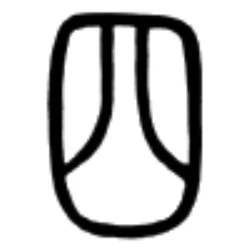
Early ways of writing four include 亖, four horizontal strokes. The familiar 四 (sì) has a different graphic history. Its enclosure should not be treated as a literal drawing of the four seasons.
The Shuowen Jiezi calls four a yin number and explains it within a correlative system. Such dictionary explanations tell us how later scholars understood a character; they are not always descriptions of its earliest invention.

A world with four quarters
East, south, west and north organize space; spring, summer, autumn and winter organize the year. 四方 (sì fāng) and 四时 (sì shí) can therefore evoke completeness. 四海 (sì hǎi, the four seas) is often a literary expression for the whole known world, not a precise list of four named bodies of water.
The four celestial emblems place the Azure Dragon in the east, the Vermilion Bird in the south, the White Tiger in the west and the Dark Warrior—usually a tortoise entwined with a snake—in the north. Their astronomical and seasonal associations developed over time.
East · Spring
青龙 (qīng lóng), Azure Dragon.
South · Summer
朱雀 (zhū què), Vermilion Bird.
West · Autumn
白虎 (bái hǔ), White Tiger.
North · Winter
玄武 (xuán wǔ), Dark Warrior.
Four as a portable library
Grouping things in fours makes knowledge easy to carry in memory. Some familiar lists are old textual classifications; others are later selections that became widely accepted. The “Four Great Towers,” for example, have more than one popular list.
Four Treasures of the Study
文房四宝 (wén fáng sì bǎo): brush, ink, paper and inkstone—the tools of writing and painting.
Four Books
四书 (sì shū): Great Learning, Doctrine of the Mean, Analects and Mencius, central to later Confucian education.
Four great novels
三国演义, 水浒传, 西游记 and 红楼梦: the now-familiar grouping of Romance of the Three Kingdoms, Water Margin, Journey to the West and Dream of the Red Chamber.
Four Gentlemen
四君子 (sì jūn zǐ): plum, orchid, bamboo and chrysanthemum, plants associated with cultivated character.
Four inventions
Papermaking, printing, the compass and gunpowder: a modern educational grouping of major Chinese technological contributions.
Four moral supports
四维 (sì wéi): ritual propriety, rightness, integrity and a sense of shame. Mencius’s 四端 (sì duān) instead names four beginnings of ethical feeling.
Four sides, four joys
A 四合院 (sì hé yuàn) gathers buildings around a courtyard. Its practical arrangement offers an image of an enclosed, shared household. 四世同堂 (sì shì tóng táng), four generations under one roof, expresses another family ideal, even when actual living arrangements differ.
Celebratory language gathers four happy occasions: rain after a long drought, meeting an old friend far from home, a wedding night and success in the examinations. Four happiness meatballs, 四喜丸子 (sì xǐ wán zi), bring festive completeness to the table; explanations of their four blessings vary.
Dates, peanuts, longans and lotus seeds can be combined as wedding wordplay wishing for children. Local “four red” clothing customs also occur. They should not be confused with a universal four-stage wedding ritual: the classical marriage sequence is usually described as six rites, not the first four rites alone.
The older “four virtues” prescribed for women record historical expectations about conduct, speech, appearance and work. Presenting them accurately requires recognizing the restrictions of that social order.
A complete world—and an uncomfortable sound
四 (sì) resembles 死 (sǐ, death) in Mandarin, and related sound associations occur in other Chinese varieties. Avoidance of four in room numbers or gifts coexists with positive four-part traditions. Neither response represents every Chinese speaker, and the taboo has no single simple origin.
Buddhist 四大 (sì dà) refers to earth, water, fire and wind as qualities of material existence. Saying that they are “empty” concerns their lack of independent, permanent nature; it is not simply the assertion that nothing exists. Traditional medicine also relates four-season changes to the body, while 四肢 (sì zhī) is the everyday expression for the four limbs.
Numbers in everyday words.
Open a group to read the Chinese, its pronunciation and the English meaning together. This collection includes idioms, sayings and popular phrases. Pinyin uses dictionary tones; natural speech may change the tone of 一 and 不.
Expressions 01–10
四分五裂
Split into many pieces; fragmented or disunited.
四六不懂
To be ignorant of basic sense or propriety; the phrase’s exact numerical origin is uncertain.
四面八方
All around; in every direction.
四平八稳
Stable and well balanced; sometimes cautious to the point of lacking initiative.
四通八达
Roads leading everywhere: excellent connections and easy access.
四时八节
The four seasons and eight seasonal nodes: the year in its full cycle.
四亭八当
Properly arranged, balanced and appropriate in every respect.
四海为家
To make a home wherever one goes.
四大皆空
The four material elements are empty of independent, permanent nature in Buddhist thought; popularly, detachment from worldly concerns.
四脚朝天
All four limbs pointing upward: flat on one’s back or completely overturned.
Expressions 11–20
四海升平
Peace and prosperity throughout the realm.
四面楚歌
Chu songs on every side: utterly surrounded and isolated, from the story of Xiang Yu’s final defeat.
四体不勤
Not putting one’s limbs to work; lacking experience of physical labor.
四海之内皆兄弟
Within the four seas, all are brothers: fellowship beyond one’s immediate family.
三从四德
The “three obediences and four virtues” imposed on women in traditional patriarchal ethics; a historical institution, not a present-day recommendation.
三老四少
People of different ages; old and young alike.
三妻四妾
A household imagined with many wives and concubines; a figurative expression of a historically unequal marriage system, not a precise legal count.
三朋四友
A circle of friends and companions.
三番四复
Repeatedly; a less common expression for recurrence.
三番五次
Again and again; repeatedly.
Expressions 21–30
五湖四海
Five lakes and four seas: people or places from far and wide.
家徒四壁
A home with only four bare walls: extreme poverty.
志在四方
Ambition reaching the four directions: determination to seek achievement beyond home.
颠三倒四
Confused in sequence; speaking or acting without a clear order.
低三下四
Servile, excessively deferential or lacking dignity.
说三道四
To gossip or make indiscreet comments about others.
挑三拣四
To pick and choose excessively; be overly fussy.
朝三暮四
Three in the morning, four at night: now often fickleness or changing one’s mind; its monkey story exposes an unchanged total disguised by rearrangement.
推三阻四
To put up one excuse or obstacle after another.
不三不四
Improper or neither one thing nor another; a disparaging expression.
Expressions 31–31
丢三落四
Forgetful and careless, repeatedly leaving things out or behind.
Reading note: the English text adapts and reorganizes the supplied Chinese document. Character diagrams and illustrations are reproduced from that source; they are not presented as authenticated archaeological objects. Numerical diagrams are modern explanatory designs.